Software Development Outsourcing
2027 Software Development Outsourcing Guide for Founders and SMEs
This guide covers how software outsourcing works, which models exist, what it costs in the US market, and how to pick an outsourcing partner you can trust. It also shows where software development outsourcing goes wrong and how to prevent it. Each section gives you something to act on this week.
10 min read · Nov 19, 2026 · Prashant Kumar
Software development outsourcing means hiring an outside team to design, build, or maintain your software while you keep ownership of the product. Founders use it to reach a first release without a hiring cycle. SME owners use it to replace tools that no longer fit how the business runs.
This guide covers how software outsourcing works, which models exist, what it costs in the US market, and how to pick an outsourcing partner you can trust. It also shows where software development outsourcing goes wrong and how to prevent it. Each section gives you something to act on this week.
What is software development outsourcing?
Software development outsourcing is an arrangement where an outsourcing company supplies software developers, designers, and testers for your project. You own the product, the roadmap, and the source code. The vendor owns the delivery process and the people doing the work.
The arrangement covers a wide range. Some companies hand over a whole product, from discovery through launch and support. Others add two or three software engineers to an internal team. Both count as software development outsourcing. The difference is how much responsibility moves to the vendor.
Two kinds of buyers use it most.
- Startups without a development team outsource to build a first version and win early customers. That path is software product development, and it often starts with an MVP.
- Small and mid-size businesses outsource to build internal software that replaces spreadsheets, disconnected apps, and manual workarounds. That path is custom business software.
This guide applies to both.
Why companies outsource software development
Most buyers choose software development outsourcing for one of five reasons. Knowing yours helps you pick the right model and the right outsourcing partner.
- A wider talent pool: Senior engineers in machine learning, mobile, and cloud are hard to hire in one city. A software outsourcing company gives you a talent pool far beyond your own commute radius and can fill a role in weeks instead of months.
- A faster start: Hiring, onboarding, and building a development process takes months. A vendor's development teams already have tools, workflows, and code review habits in place, so your project can start in a few weeks.
- A flexible team size: Product demand changes faster than headcount. You can add software developers before a launch and scale down after it, without layoffs or long contracts.
- Lower total cost: Cost savings come from skipping recruitment fees, office space, equipment, and idle time between projects. Compare total delivery cost, not hourly rates alone. A cheap rate that causes rework costs more than a fair rate that ships once.
- More time for your core business: Your leadership time is limited. When an outside team handles the software engineering, you can spend that time on customers, sales, and operations.
When outsourcing software development is the wrong call
Outsourcing doesn't fit every situation. Keep the work inside, or use a hybrid approach, in these five cases.
- Your core technology is your edge: If your own algorithm or architecture sets you apart, build it with your own people and outsource the work around it.
- Regulations limit who can touch your data: Some rules restrict where data lives and who can access it. Check this before you sign anything.
- Your project requirements change every week: Outsourcing works when goals are clear. If they aren't, start with a short discovery phase.
- Nobody on your side owns the relationship: An outsourced team needs one person who sets priorities and answers questions within a day.
- The job is small: A fix that takes three days costs less with a freelancer or your internal team than with a new vendor. Most software development projects below that size don't justify the onboarding effort.
In-house vs outsourcing software development
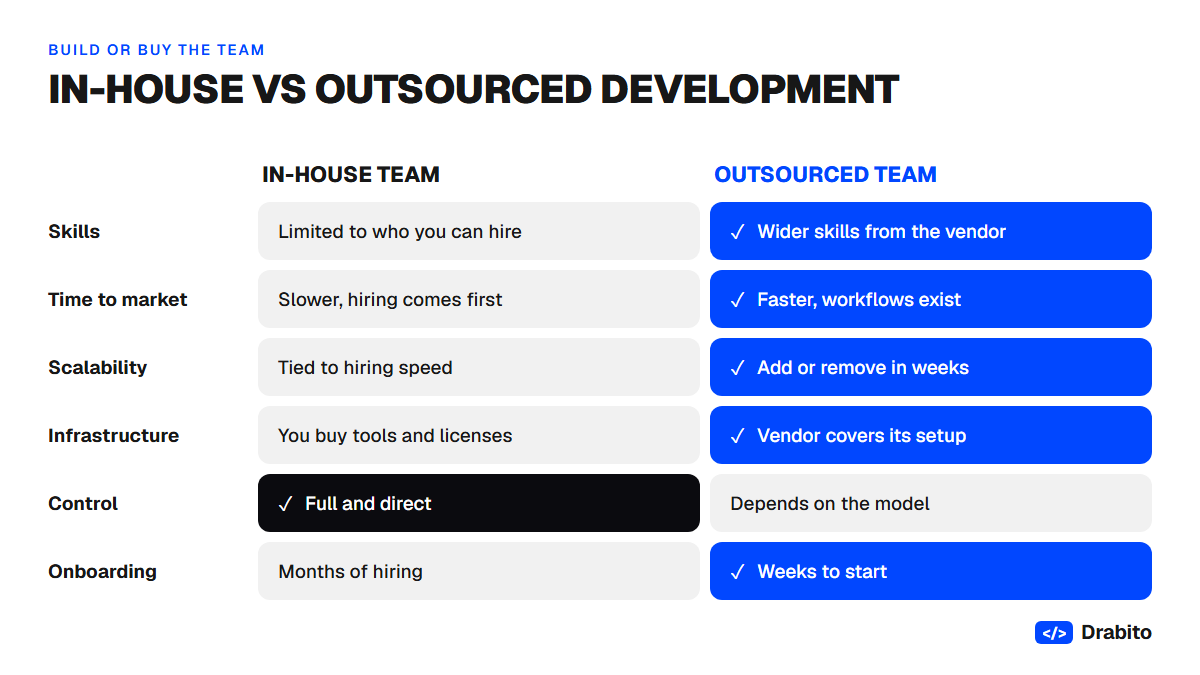
The choice between in-house vs outsourcing software development is rarely all or nothing. The table below compares the two across the factors that matter most to a growing company.
| Factor | In-house team | Outsourced team |
| Skills | Deep product knowledge, limited to who you can hire | Wider skills, based on the engineers the vendor assigns |
| Time to market | Slower, because hiring comes first | Faster, because workflows already exist |
| Scalability | Tied to your hiring speed | Add or remove developers within weeks |
| Infrastructure | You buy tools, hardware, and licenses | The vendor covers its own setup |
| Control | Full and direct | Depends on the engagement model |
| Onboarding | Months of hiring and training | Weeks, since engineers arrive project-ready |
Many companies land on a hybrid. They keep product ownership and architecture decisions in-house, and they use external teams for build capacity. This setup gives you control where it matters and speed everywhere else.
A simple test helps you decide. If a task needs deep knowledge of your customers, keep it in-house. If it needs a skill you can't hire this quarter, outsource it.
Software development outsourcing models
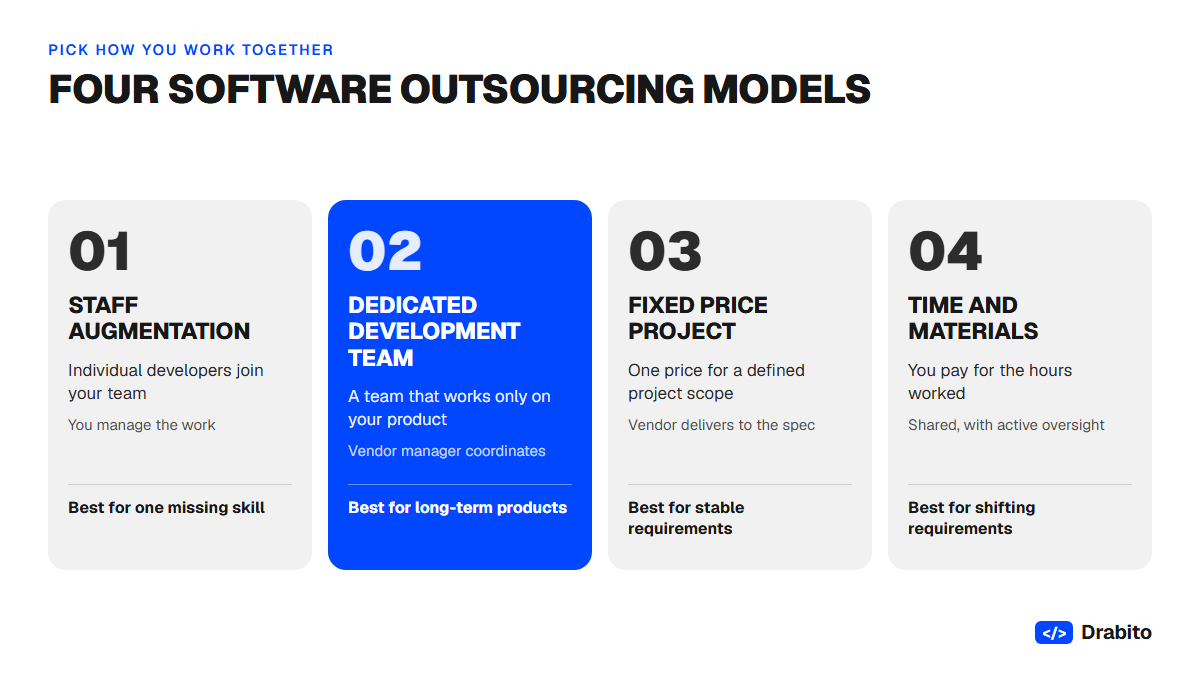
The model decides who manages the daily work and who carries the risk. Four software development outsourcing models cover most projects.
Staff augmentation
Staff augmentation adds individual developers to your internal team. You manage their work and set their priorities. The vendor handles recruiting and payroll. This model suits teams that need extra hands or one missing skill.
Dedicated development team
A dedicated development team works only on your product. A vendor-side manager handles daily coordination while you set the roadmap. A managed team can ramp up in four to six weeks. This model fits long-term product development.
Fixed price project
A fixed price contract sets one price for a defined project scope. It works when requirements are stable and the deadline is firm. Any change to the scope of work triggers a new quote.
Time and materials
Time and materials means you pay for the hours worked. It fits discovery work and products where requirements will shift. You need active oversight to control spend.
Some vendors also price by milestone or result. These outcome-based contracts work when both sides agree on what done means before the work starts.
Many buyers start with time and materials during discovery, then switch to a fixed price project once the scope settles. Others begin with staff augmentation and move to a dedicated development team as the product grows.
Onshore, nearshore, and offshore outsourcing
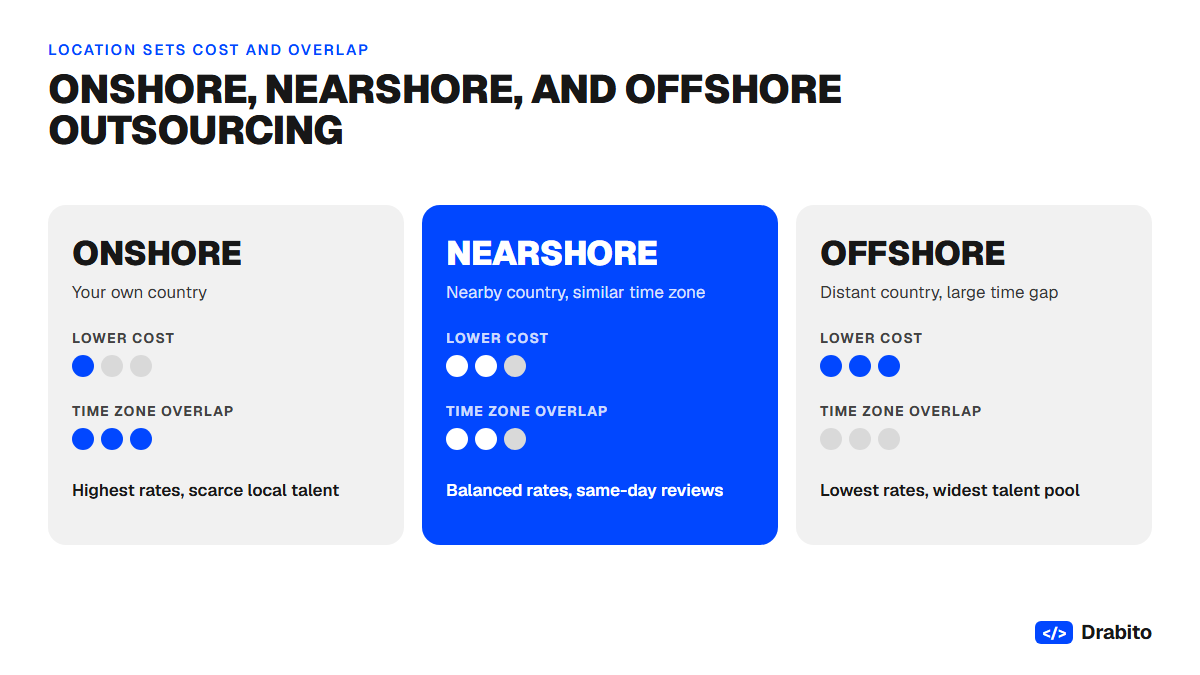
Location sets three things you feel every day. These are cost, time zone alignment, and how much you need to write down.
Onshore
Onshore means a vendor in your own country. You share time zones, language, and law. Rates are the highest, and local software developers are in short supply.
Nearshore
Nearshore means a nearby country in a similar time zone. A US company that works with a team in Latin America gets real-time overlap at lower rates. Reviews, standups, and bug fixes happen the same day.
Offshore
Offshore means a distant country with a large time difference. It gives you the widest talent pool and the lowest rates. It works best for well-defined projects with clear documentation. Offshore software development calls for more written communication.
Reshoring means moving outsourced work back to your home country. Companies do it for data residency or compliance reasons. Write handover terms into the contract so you can reshore without losing knowledge.
Top outsourcing destinations for US buyers
Three regions attract most US buyers. Each trades cost against time zone overlap in a different way.
Latin America
Latin America shares US time zones, so your team can collaborate in real time through the full workday. Brazil, Mexico, and Colombia have large talent pools in SaaS and fintech software engineering. You can also visit the team in person after a short flight.
Eastern Europe
Eastern Europe, including Poland, Romania, Ukraine, and Bulgaria, has deep engineering talent and strong technical education. Teams there overlap with the morning hours on the US East Coast. EU membership brings GDPR alignment and established IP protection.
Asia
India, the Philippines, and Vietnam offer the largest talent pools and the lowest rates. India has a long track record with US clients. The time zone gap means more written communication and a tighter development process.
Pick the region that matches your work style. If your team reviews code daily, choose a nearshore partner. If your scope is well defined and your budget is tight, offshore software development can stretch each dollar further.
Software outsourcing trends to watch in 2026
Buyers who ask about the latest trends in software development outsourcing usually want to know what changes their next contract. Four shifts matter most right now.
- AI moves the bottleneck to code review. Developers write code faster with AI tools, so reviewing it takes the most senior time. Ask any outsourcing provider how its engineers review AI-generated code.
- Outcome-based pricing grows. More vendors price by milestone or result instead of hours, because AI weakens the link between hours and value.
- Nearshore keeps gaining ground. Shared working hours speed up reviews and collaboration, which is where delivery slows down.
- Teams skew senior. Fewer engineers handle routine tasks, and more senior engineers review and own the architecture. The blended rate rises, and so does the value of each hour.
How much does software development outsourcing cost?
Three things set the price of software development outsourcing. These are where the team sits, how you contract, and how senior the engineers are. Seniority is the one buyers underestimate.
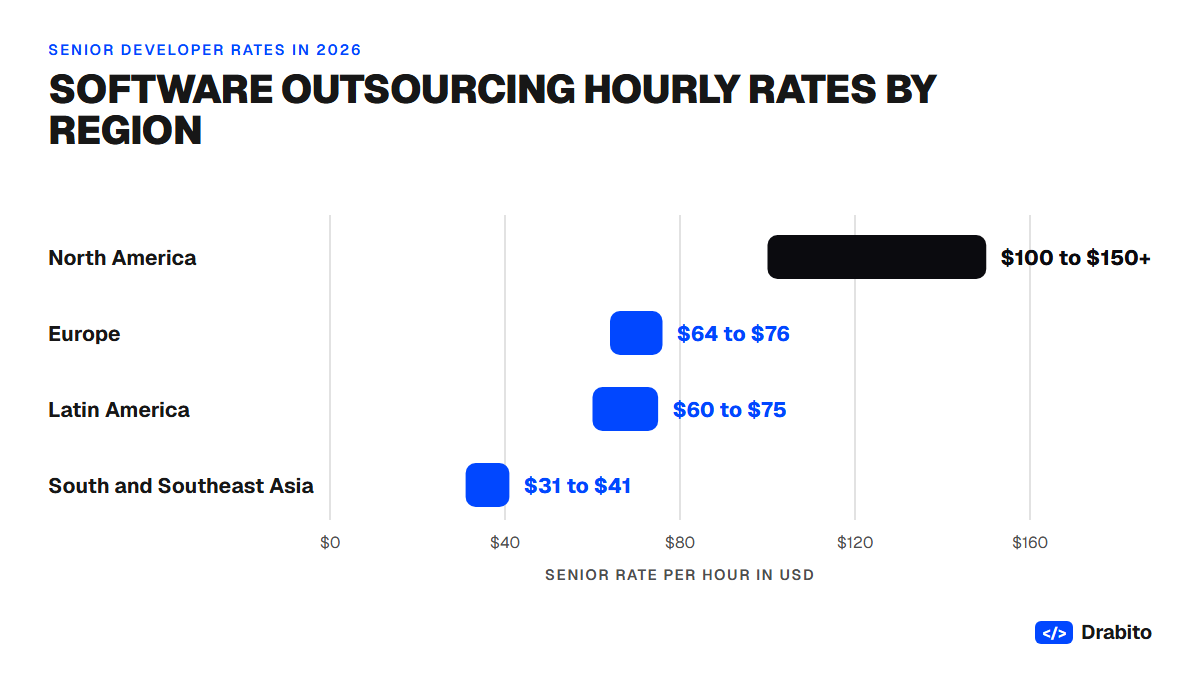
Published 2026 rate guides from Accelerance and TechQuarter put senior developer rates at $64 to $76 an hour in Europe, $60 to $75 in Latin America, and $31 to $41 in South and Southeast Asia. Senior developers in North America run from $100 to $150 or more an hour.
| Region | Cost of Junior Dev per hour | Cost of Senior Dev per hour |
| Europe | $31 to $39 | $64 to $76 |
| Latin America | $33 to $45 | $60 to $75 |
| South and Southeast Asia | $24 to $31 | $31 to $41 |
| North America | Varies by market | $100 to $150 or more |
Hidden costs outside the hourly rate
The hourly rate covers engineering time only. These hidden costs sit on top of your development costs, and most of them land on your side.
- Onboarding and setup. Expect two to four weeks of reduced output while the team learns your product.
- Knowledge transfer time. Your internal team spends hours explaining business rules and past decisions.
- Tools, licenses, and infrastructure. Check whether the vendor includes them in the rate.
- Project management time. Someone on your side must own the relationship and answer questions.
- Scope changes. Each contract type prices them differently.
- Handover work. Documentation and credential transfer take time at the end of the engagement.
Add rework to the math. A low rate that forces you to rebuild a feature costs more than a fair rate that ships it right the first time.
How to choose a software outsourcing company
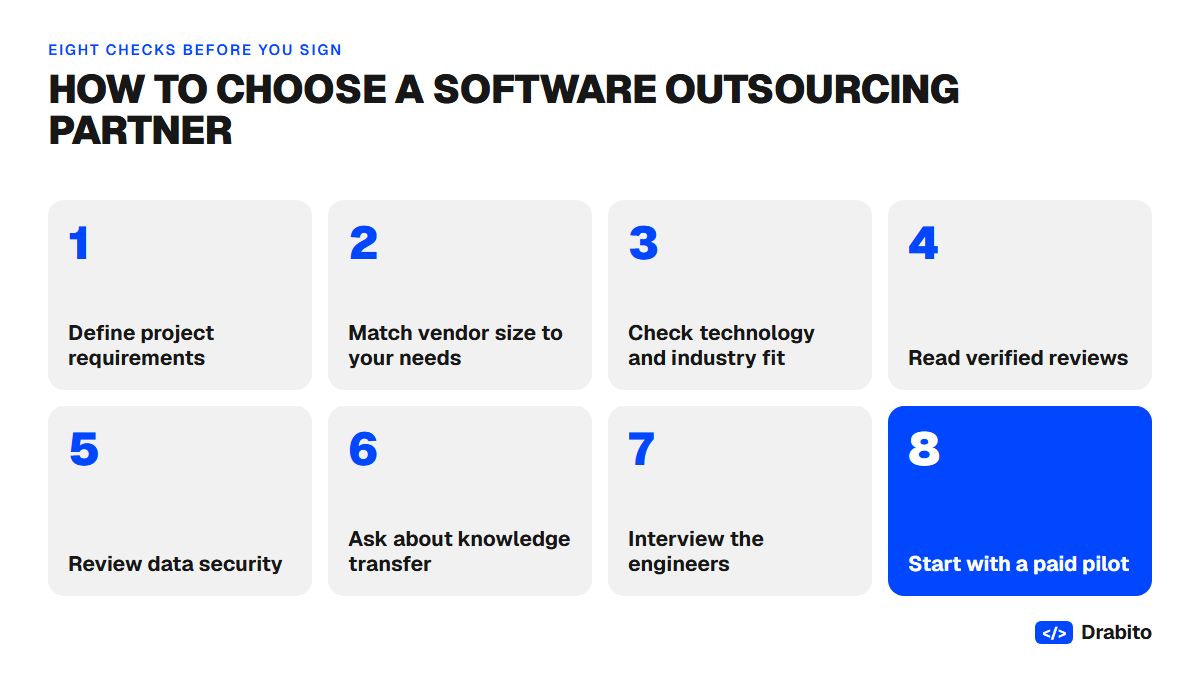
You can see most signals about a future partnership before you sign. If you're wondering how to outsource software development without regret, use these eight checks in order. They help you find a development partner who fits your plan.
- Define your project requirements: Write a brief with the product scope, project goals, timeline, budget range, and required skills. Vendors answer a specific brief with a specific proposal, so you can compare them fairly.
- Match vendor size to your needs: A large outsourcing company can scale a team fast. A small development agency gives you more attention on a focused job. Pick the size that fits your next 12 months.
- Check technology and industry experience: Confirm the outsourcing provider has shipped with your stack. Ask for a case study in your industry. A team that already knows your compliance rules saves you weeks.
- Read verified reviews: Clutch and GoodFirms publish client interviews, not hand-picked quotes. A steady rating across many reviews is a reasonable sign of a dependable partner.
- Review data security: Ask whether the vendor follows ISO 27001 and runs regular security audits. Ask how it controls access to sensitive information, and what happens to your data when the engagement ends.
- Ask about knowledge transfer: Project knowledge piles up fast. A good plan names who documents it, who receives it, and how, through demos, written guides, and recorded walkthroughs.
- Interview the engineers: Meet the software engineers who will do the work, not only the sales team. Ask how they handle technical disagreements, and how they run code reviews on AI-generated code.
- Start with a paid pilot: A short paid engagement on real code tells you more than any reference call. Keep the scope narrow. Agree up front on what would make you stop.
Look at real software development services work too. A case study that shows a named client, a clear problem, and a measured result tells you more than a long list of logos.
Contracts, intellectual property, and security
A clear contract prevents most disputes. The table below lists the clauses that do the most work.
| Clause | What it should say |
| Scope of work | Deliverables, acceptance criteria, and a clear definition of done |
| Pricing and payments | Contract type, payment schedule, and how change requests get priced |
| Intellectual property | All code, designs, and documents transfer to you as work is delivered |
| Confidentiality | An NDA signed before any work begins, with defined access limits |
| Data protection | Compliance terms for your industry, including where data is processed |
| Communication | Meeting rhythm, report format, named contacts, and an escalation path |
| Hiring limits | Mutual limits on hiring each other's staff for a set period |
| Exit and handover | Documentation standard, source code transfer, and a transition period |
Intellectual property deserves the most attention. The contract should assign all source code, designs, and documentation to you as the vendor delivers them, not at the end of the project. Sign the NDA before you share sensitive information, and limit access to the team members who need it.
How to manage an outsourced team
Signing the contract starts the work. These best practices keep an outsourced team on track.
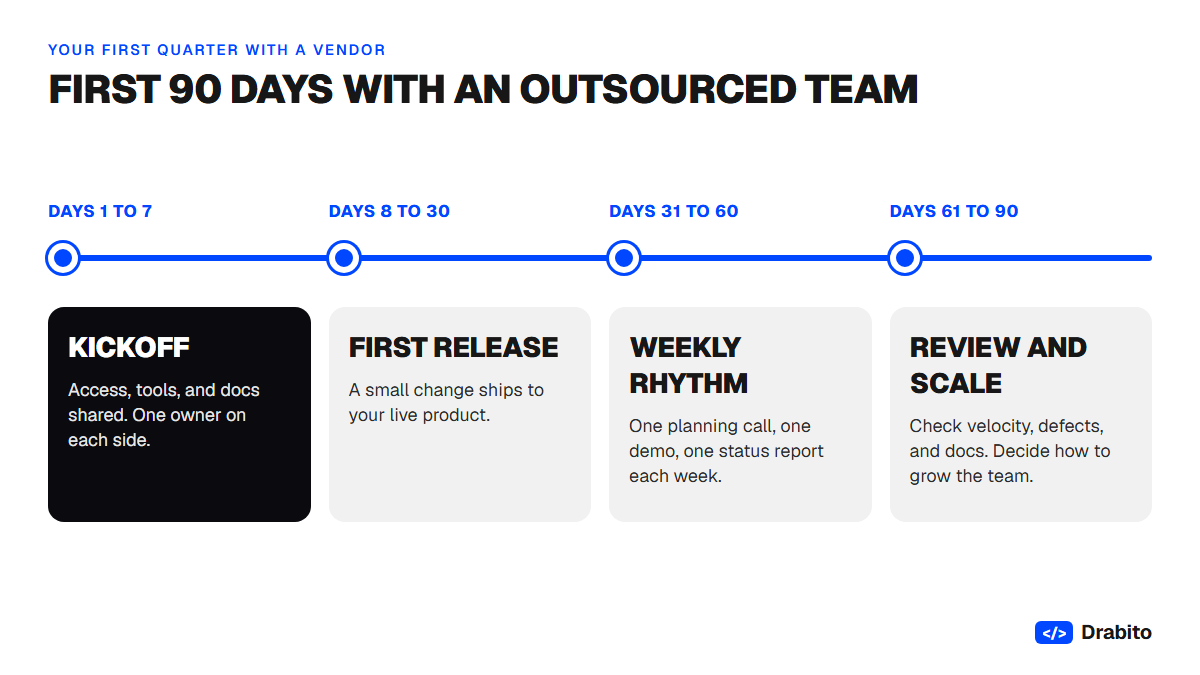
- Start with a clear kickoff. Give the team access, tools, and documentation in week one. Name one owner on each side and set clear expectations for communication. End the first sprint by shipping a small change to your live product, which proves the setup works.
- Set a weekly rhythm. Project management works best with a fixed beat. Hold one planning call, one demo, and one written status report every week. Ask the vendor's project managers to track velocity and defects so you can answer questions without asking them.
- Insist on code reviews and quality assurance. Every change should pass a code review before it ships. Quality assurance should run alongside development, not after it. Ask for test results with every release.
- Document as you go. Treat documentation as a deliverable. Write down business rules, architecture choices, and setup steps while the team still remembers them.
- Plan the exit on day one. Bringing development back to your internal team is easy when repositories, credentials, and notes stay current. It's painful when they don't.
Common software development outsourcing risks
Every software development outsourcing risk below has a fix you can put in place before work starts.
| Risk | How to fix it |
| Communication issues | Agree on tools, response times, and one overlap window each day |
| Language barriers | Test written and spoken English in the engineer interview |
| Hidden costs | Ask for a full cost breakdown that includes onboarding and handover |
| Scope creep | Price every change request in writing before work begins |
| Team turnover | Require documentation and a named backup for each role |
| Security and IP exposure | Sign an NDA, assign IP in the contract, and limit access |
| Quality gaps | Require code reviews, automated tests, and a staged release plan |
Most of these risks show up in the first 30 days. A paid pilot, a weekly demo, and a written change process catch them early, while they're still cheap to fix.
Software development outsourcing checklist
Use this list as your working plan for software development outsourcing. Each step builds on the one before it.
- Write your project requirements and success criteria.
- Choose an engagement model that fits how stable your scope is.
- Pick a region based on budget and time zone alignment.
- Shortlist three vendors and read their verified reviews.
- Interview the engineers and run a paid pilot.
- Sign a contract that covers IP, data protection, and exit terms.
- Run a structured kickoff with one owner on each side.
- Review work weekly and keep documentation current.
Share this list with your leadership team before you talk to vendors. It keeps every conversation tied to the same plan.
How Drabito handles software development outsourcing
Drabito is a custom software development studio. We work with two kinds of clients. Startups without a development team come to us for software product development, from the first MVP to every feature that takes the product toward scale. Small and mid-size businesses come to us for custom business software that replaces disconnected tools and slow vendors with one system built around how they work.
You can work with us in two ways. A dedicated team stays on as your embedded IT team, so each new bottleneck gets solved as it shows up. A single project covers one scoped job, such as the full software, a migration, or a set of fixes to something that already exists.
Every project starts with an NDA and a scoped plan. You see working software at every stage, and we quote every change upfront. When we use AI in delivery, a person reviews every output before it ships.
Ready to see what your project needs? Get your project scoped.
Frequently asked questions
What is software development outsourcing?
Software development outsourcing means hiring an outside company to build or maintain software for you. You keep the product, the roadmap, and the intellectual property. The vendor supplies software developers, project management, and the delivery process.
How much does it cost to outsource software development?
Senior rates run $31 to $41 an hour in South and Southeast Asia, $60 to $75 in Latin America, and $64 to $76 in Europe. North American senior rates run $100 to $150 or more. Budget extra for onboarding, knowledge transfer, and your own management time.
What are the main advantages and disadvantages of software outsourcing?
The advantages are access to skills, a faster start, a flexible team size, and lower total cost. The disadvantages are less direct control, time zone gaps, and the risk of knowledge loss. A clear contract and a weekly rhythm reduce each of them.
How do I protect intellectual property when outsourcing?
Assign all code, designs, and documentation to your company in the contract, effective as work is delivered. Sign an NDA before work begins. Limit access to people who need it, and confirm the vendor removes access when the project ends.
How can a non-technical founder manage an outsourced team?
Name one product owner on your side and review a working demo every week. Ask for a written status report and a short list of risks. Judge progress by working software you can click through, not by hours logged.
How long does it take to onboard an outsourced team?
Individual engineers can contribute within days to two weeks. A fully managed team takes four to six weeks to assemble and align. Clear requirements, prepared access, and current documentation shorten the ramp.
What happens if I want to bring development back in-house?
A handover clause should require current documentation, full transfer of repositories and credentials, and an overlap period where both teams work together. Plan this when you sign the contract. You own the code throughout, so nothing locks you to the vendor.